
Introduction
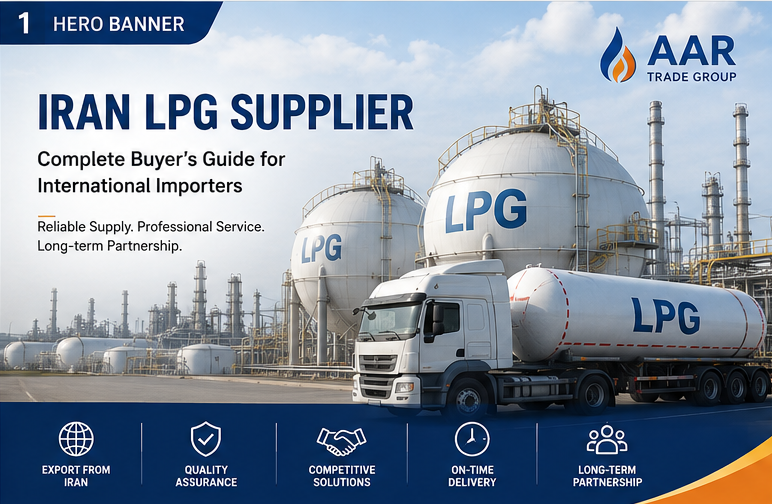
- Introduction
- Why International Buyers Choose Iran for LPG Supply
- What Is LPG?
- Products We Can Supply
- Flexible Supply Quantities
- Understanding LPG Specifications Before You Buy
- How the LPG Export Process Works
- Transportation, Delivery Terms, and Quality Assurance
- Common Mistakes Buyers Make When Importing LPG
- Why Companies Choose AAR Trade Group
- Request a Quotation
- Final Thoughts
Imagine you are responsible for purchasing LPG for a distribution company, industrial facility, or trading business. You need a supplier who can provide the right product specification, deliver on schedule, prepare the correct export documents, and communicate professionally throughout the transaction.
Finding the right supplier is often more challenging than finding the right price.
Iran is one of the important energy-producing countries in the Middle East and has long supplied LPG to neighboring markets. For buyers in Pakistan, Afghanistan, and other nearby regions, sourcing LPG from Iran can offer logistical advantages and flexible commercial solutions when handled through experienced export partners.
However, successful LPG procurement depends on much more than obtaining a quotation. Buyers should understand product specifications, delivery terms, logistics, documentation, payment conditions, and supplier capabilities before making a purchasing decision.
This guide has been prepared for procurement managers, LPG distributors, trading companies, and industrial buyers looking for practical information about sourcing LPG from Iran. Instead of focusing only on prices, it explains the commercial process, common buyer questions, and the factors that contribute to a successful long-term supply relationship.
Why International Buyers Choose Iran for LPG Supply
For companies located close to Iran, transportation costs and delivery times can often be more competitive than sourcing from more distant markets. Buyers also benefit from access to different propane and butane blends that can be matched to their technical or commercial requirements.
Many experienced importers value suppliers who can provide more than a quotation. They look for partners who can coordinate product availability, prepare export documentation, communicate clearly, and support the transaction from inquiry to delivery.
At AAR Trade Group, our focus is on helping buyers simplify that process through professional communication, flexible commercial discussions, and practical export coordination.
What Is LPG?
Liquefied Petroleum Gas (LPG) is a mixture of hydrocarbon gases, primarily propane and butane, that becomes liquid under moderate pressure. This allows it to be stored and transported efficiently before being used as fuel for industrial, commercial, agricultural, and residential applications.
Depending on climate, equipment, and intended use, buyers may require different propane-to-butane ratios. Choosing the correct blend helps improve performance and operational efficiency.
Products We Can Supply
We work with buyers looking for bulk LPG solutions and can discuss supply based on project requirements.
Typical product options include:
| Product | Availability |
|---|---|
| LPG | ✔ |
| Propane | Upon request |
| Butane | Upon request |
| LPG 50/50 | ✔ |
| LPG 60/40 | ✔ |
| LPG 70/30 | ✔ |
| Custom Ratio | Subject to availability |
Because every market has different technical requirements, buyers are encouraged to specify their preferred ratio when requesting a quotation.
Flexible Supply Quantities
Every buyer has different purchasing needs. Some companies prefer to begin with a trial shipment before entering into larger supply agreements.
Depending on product availability and commercial arrangements, supply discussions may include:
- Trial truck shipments for evaluation.
- Regular truck deliveries for nearby markets.
- Bulk supply for larger projects.
- Ongoing supply programs for long-term customers.
Discussing the expected monthly demand during the initial inquiry helps both parties plan logistics more effectively.
Understanding LPG Specifications Before You Buy
One of the biggest mistakes in international LPG trading is requesting a quotation without clearly defining the required product specifications. While price is naturally important, experienced buyers understand that the correct specification is just as critical as the commercial terms.
Before requesting an offer, buyers should determine the intended application of the LPG, the preferred propane-to-butane ratio, the required quantity, delivery location, and the preferred Incoterm. Providing this information at the beginning of the discussion allows the supplier to prepare a more accurate and competitive quotation.
Different industries use LPG for different purposes. A fuel distributor may require a different composition than an industrial manufacturer or a commercial gas supplier. Climate conditions, storage facilities, and transportation methods may also influence the preferred product specification.
Propane and Butane: What’s the Difference?
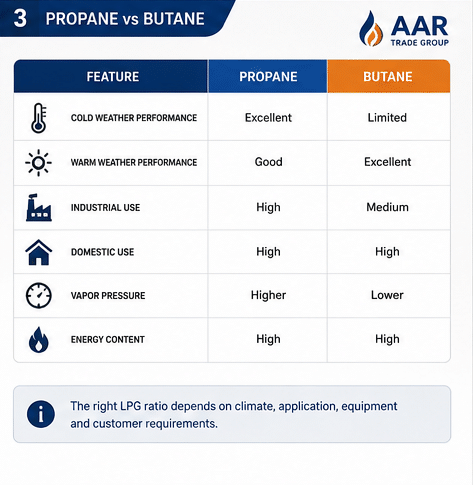
LPG is generally composed of propane, butane, or a combination of both. Although these gases are similar, they have different characteristics that affect their performance.
Propane has a lower boiling point, making it suitable for colder environments and applications where reliable vaporization is required. It is commonly used for industrial heating, manufacturing, agriculture, and commercial fuel systems.
Butane performs well in warmer climates and is widely used in domestic gas distribution, portable fuel applications, and certain industrial processes. Because butane has a lower vapor pressure than propane, it behaves differently during storage and transportation.
For many international buyers, neither pure propane nor pure butane is the ideal solution. Instead, they require a balanced LPG blend that matches the technical requirements of their market.
Available LPG Ratios
At AAR Trade Group, commercial discussions can include several LPG blend options, depending on product availability and buyer requirements.
| LPG Blend | Typical Commercial Application |
|---|---|
| 50% Propane / 50% Butane | General industrial and commercial applications |
| 60% Propane / 40% Butane | Markets requiring higher propane content |
| 70% Propane / 30% Butane | Colder regions or specialized industrial use |
| Custom Ratio | Prepared according to buyer requirements and product availability |
The final product specification should always be confirmed before the quotation stage to ensure both parties have the same technical understanding.
Choosing the Right Blend
Selecting the correct LPG ratio depends on several factors, including:
- Climate conditions in the destination country
- Industrial or commercial application
- Local regulations
- Storage and handling facilities
- Customer preferences
- Distribution system requirements
Rather than choosing a product based only on price, buyers should consider which blend offers the best long-term performance for their specific operation.
Procurement Tip
When requesting a quotation, include the required LPG ratio, quantity, destination, preferred Incoterm, and expected delivery schedule. Complete information allows suppliers to prepare a faster, more accurate commercial offer and helps avoid unnecessary revisions during negotiations.
Bulk Supply Options
Bulk LPG is generally the preferred choice for commercial importers, distributors, and industrial users because it offers greater efficiency for larger volumes.
Depending on the project and logistics, supply discussions may include:
- Truck deliveries for neighboring markets
- Regular scheduled shipments
- Bulk cargo for larger commercial projects
- Long-term supply programs for recurring demand
The most appropriate transportation method depends on the destination, order volume, and commercial agreement between buyer and seller.
Why Product Specification Matters More Than Price
Many first-time buyers compare quotations from several suppliers without confirming that each quotation is based on exactly the same product specification.
This often leads to confusion because two prices may appear different while the product quality, LPG ratio, delivery terms, or commercial conditions are not identical.
Professional procurement teams compare quotations only after confirming that all suppliers are quoting the same specification, quantity, delivery term, and destination. This approach reduces commercial risk and makes supplier evaluation much more reliable.
How the LPG Export Process Works
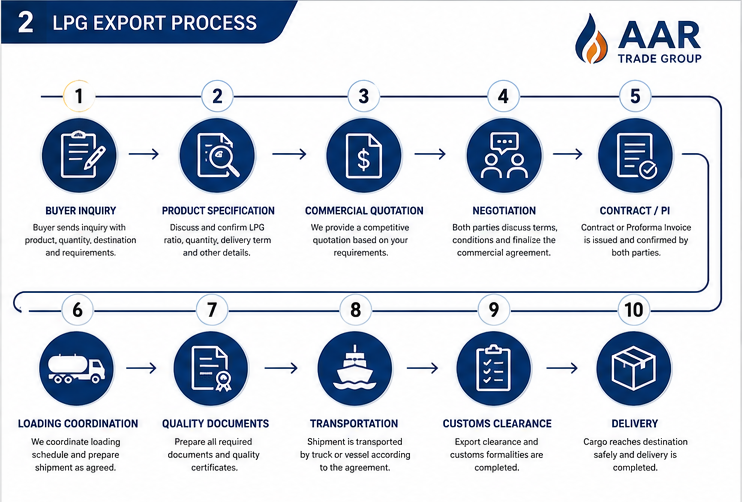
Importing LPG is more than purchasing a product. It requires coordination between the buyer, supplier, logistics providers, customs authorities, and financial institutions. Understanding the export process helps buyers reduce delays, avoid misunderstandings, and complete transactions more efficiently.
Although every project is different, the following steps represent a typical international LPG transaction.
Step 1 – Send a Detailed Inquiry
A professional inquiry should include more than just “Please send your best price.”
The more information the buyer provides, the more accurate the quotation will be.
We recommend including:
- Required product (LPG, Propane, Butane)
- Preferred propane/butane ratio
- Required quantity
- Destination country
- Delivery location
- Preferred Incoterm (FCA, FOB, etc.)
- Expected delivery date
- Intended application (if applicable)
Providing complete information allows suppliers to evaluate the project quickly and avoid unnecessary revisions during the negotiation stage.
Step 2 – Commercial Evaluation
After receiving the inquiry, the supplier reviews the commercial and technical requirements.
This evaluation generally includes:
- Product availability
- Required LPG specification
- Loading location
- Transportation options
- Estimated delivery schedule
- Export feasibility
If additional information is required, both parties clarify the requirements before preparing a quotation.
Step 3 – Quotation
Once the project has been evaluated, the supplier prepares a commercial offer.
A professional quotation normally includes:
- Product description
- LPG ratio
- Quantity
- Unit price
- Delivery term
- Validity period
- Estimated delivery schedule
- Payment conditions
Experienced buyers compare quotations only after confirming that all suppliers are quoting the same product specification and delivery terms.
Step 4 – Commercial Negotiation
After reviewing the quotation, both parties discuss the commercial details.
Typical discussion points include:
- Quantity adjustments
- Delivery schedule
- Payment terms
- Documentation requirements
- Inspection requirements
- Transportation arrangements
The objective is to establish a clear understanding before production or loading begins.
Step 5 – Contract Confirmation
Once the commercial terms have been agreed, the buyer and seller confirm the transaction through the appropriate commercial documents.
Depending on the project, this may include:
- Proforma Invoice (PI)
- Sales Contract
- Purchase Order
- Other mutually agreed commercial documents
The documentation should clearly define the agreed product specification, quantity, delivery terms, payment conditions, and responsibilities of each party.
Step 6 – Product Preparation and Loading
After commercial confirmation, the supplier coordinates product preparation and loading according to the agreed schedule.
Depending on the destination and logistics plan, delivery may be arranged through border loading points or other agreed export locations.
Our objective is to maintain clear communication throughout this stage so buyers can monitor the progress of their shipment.
Step 7 – Export Documentation
Preparing accurate export documentation is one of the most important parts of international trade.
Depending on the destination country and customer requirements, documents may include:
- Commercial Invoice
- Packing List
- Certificate of Origin
- Certificate of Analysis (COA)
- Material Safety Data Sheet (MSDS)
- Transport Documents
- Other documents requested by the buyer or required by the destination authorities
Document requirements vary from country to country, and they should always be confirmed before shipment.
Step 8 – Delivery and After-Sales Support
A successful transaction does not end when the cargo leaves the loading point.
Professional suppliers continue to support buyers by:
- Providing shipment updates
- Assisting with documentation
- Responding to commercial questions
- Supporting future supply planning
- Building long-term business relationships
At AAR Trade Group, we believe long-term cooperation is built on transparent communication, reliable scheduling, and practical support throughout the export process rather than focusing only on the initial sale.
Exporter Insight
One of the most common causes of delays in international trade is incomplete information during the inquiry stage. Buyers who provide detailed product specifications, destination, quantity, and delivery requirements usually receive faster quotations and experience smoother transactions throughout the supply process.
Transportation, Delivery Terms, and Quality Assurance
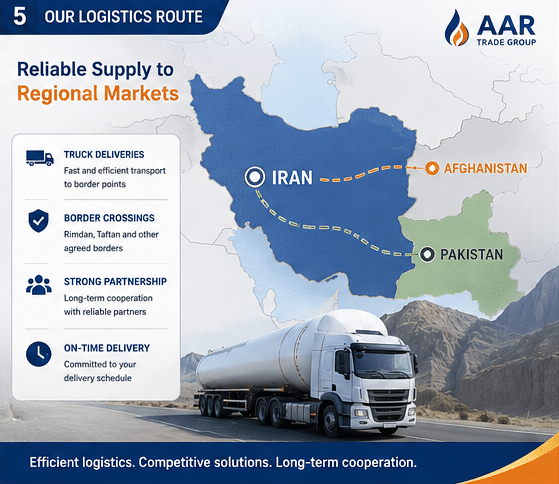
Selecting the right supplier is only one part of a successful LPG transaction. Buyers should also understand how transportation, delivery terms, documentation, and quality assurance influence the overall purchasing process.
A competitive price has little value if the shipment is delayed, the documentation is incomplete, or the delivered product does not match the agreed specification. Professional procurement focuses on the complete transaction rather than price alone.
Understanding Incoterms
One of the first commercial points discussed during an LPG inquiry is the delivery term. International Commercial Terms (Incoterms) define the responsibilities of both the buyer and seller during transportation.
Depending on the project, AAR Trade Group can discuss supply based on commercially agreed delivery terms such as:
FCA (Free Carrier)
Under FCA, the seller delivers the cargo to the agreed location where it is handed over to the buyer’s nominated carrier. This option is often preferred by experienced buyers who arrange their own transportation.
FOB (Free On Board)
For shipments through ports, FOB means the seller is responsible for delivering and loading the cargo onto the nominated vessel. Once the cargo is loaded, responsibility transfers according to the agreed Incoterms.
The most suitable delivery term depends on the buyer’s logistics capabilities, destination, and commercial strategy.
Border Delivery for Neighboring Markets
For buyers in neighboring countries such as Pakistan and Afghanistan, border delivery may provide an efficient logistics solution.
Depending on the commercial agreement and logistics planning, deliveries can be coordinated through mutually agreed border crossing points.
Choosing the appropriate delivery location requires consideration of customs procedures, transportation costs, and delivery schedules.
Choosing the Right Transportation Method
Transportation planning depends on several factors, including order volume, destination, and delivery timeline.
Commercial discussions may include:
- Truck deliveries for nearby destinations
- Multiple scheduled truck shipments
- Bulk shipments for larger projects
- Long-term supply arrangements for recurring demand
The transportation method should always match the buyer’s operational requirements and available infrastructure.
Quality Assurance
Reliable LPG supply is based on more than competitive pricing. Buyers should receive product that matches the agreed commercial specification.
Before confirming an order, buyers are encouraged to discuss:
- Product specification
- Propane and butane ratio
- Required documentation
- Inspection requirements
- Delivery schedule
- Loading arrangements
Clear communication before shipment reduces misunderstandings and contributes to a more efficient transaction.
Export Documentation
International LPG shipments require accurate documentation to support customs clearance and commercial transactions.
Depending on the destination country and customer requirements, documentation may include:
- Commercial Invoice
- Packing List
- Certificate of Origin
- Certificate of Analysis (COA)
- Material Safety Data Sheet (MSDS)
- Transport Documents
- Additional documents requested by the buyer
Document requirements vary by country, and buyers are encouraged to confirm specific requirements before shipment.
Inspection
Many professional buyers choose to arrange product inspection before shipment.
Inspection can provide additional confidence that the cargo corresponds to the agreed commercial specification and documentation.
Inspection requirements should be discussed during the negotiation stage so that both parties clearly understand the inspection process and responsibilities.
Procurement Checklist Before Confirming an Order
Before issuing a purchase order, buyers should review the following points:
✓ Product specification confirmed
✓ LPG ratio confirmed
✓ Quantity confirmed
✓ Delivery location confirmed
✓ Incoterm agreed
✓ Documentation requirements agreed
✓ Inspection requirements clarified
✓ Payment terms agreed
✓ Estimated delivery schedule confirmed
✓ Contact persons assigned for both parties
Completing this checklist before shipment significantly reduces the likelihood of delays, misunderstandings, and unnecessary commercial disputes.
Procurement Tip
Experienced procurement managers evaluate suppliers based on reliability, communication, documentation, delivery performance, and technical understanding—not only on the lowest quoted price. A supplier who consistently delivers according to the agreed specification often provides greater long-term value than one offering the lowest initial quotation.
Common Mistakes Buyers Make When Importing LPG
Purchasing LPG in the international market involves more than comparing prices from different suppliers. Every transaction includes commercial, technical, logistical, and documentation requirements that should be carefully reviewed before confirming an order.
Experienced procurement teams understand that a successful purchase depends on planning, communication, and selecting the right business partner. Below are some of the most common mistakes that buyers should avoid when sourcing LPG internationally.
1. Comparing Prices Without Comparing Specifications
One of the most common purchasing mistakes is requesting quotations from several suppliers and selecting the lowest price without confirming that all quotations are based on the same product specification.
For example, two suppliers may offer different prices because they are quoting different propane and butane ratios, different delivery terms, or different loading locations.
Always compare quotations based on identical specifications before making a commercial decision.
2. Sending an Incomplete Inquiry
Many inquiries simply state:
“Please send your best price for LPG.”
This makes it difficult for suppliers to prepare an accurate quotation.
A professional inquiry should include:
- Product required
- Propane and butane ratio
- Quantity
- Destination
- Preferred Incoterm
- Expected delivery schedule
The more information provided, the faster and more accurate the quotation.
3. Focusing Only on Price
A lower price does not always mean a better purchase.
Professional buyers evaluate suppliers based on:
- Product quality
- Technical understanding
- Delivery reliability
- Documentation support
- Communication
- Long-term cooperation
A dependable supplier who delivers according to the agreed schedule can often provide greater value than a supplier offering the lowest initial quotation.
4. Ignoring Delivery Terms
Some buyers accept a quotation without fully understanding whether the price is based on FCA, FOB, or another delivery term.
Delivery terms directly affect transportation responsibilities, costs, and risk allocation.
Always clarify the agreed Incoterm before confirming an order.
5. Not Confirming Documentation Requirements
Each destination country may require different import documents.
Waiting until the shipment is ready before discussing documentation can lead to delays during customs clearance.
Document requirements should be confirmed during the negotiation stage.
6. Choosing a Supplier Only by Price
A reliable supplier should offer more than competitive pricing.
Buyers should also evaluate:
- Professional communication
- Ability to coordinate shipments
- Flexibility in commercial discussions
- Transparency during negotiations
- Commitment to long-term business relationships
The strongest supplier is often the one who consistently delivers what has been agreed.
7. Failing to Plan Long-Term Supply
Many companies negotiate every shipment as an independent transaction.
Businesses with regular LPG demand often benefit from establishing long-term commercial relationships with suppliers who understand their technical requirements and delivery schedules.
Long-term cooperation can improve planning, communication, and operational efficiency for both parties.
Why Companies Choose AAR Trade Group
At AAR Trade Group, our objective is not simply to supply LPG. We aim to build long-term partnerships based on transparency, professional communication, and reliable export coordination.
Our approach includes:
- Clear and timely communication throughout the transaction
- Flexible discussions based on buyer requirements
- Support with export documentation
- Coordination of delivery schedules
- Assistance with product specifications and commercial inquiries
- Commitment to long-term business relationships
Every inquiry is different. Rather than offering a standard solution, we work with buyers to understand their project requirements and identify the most suitable commercial approach.
Whether the requirement is an initial trial shipment or a long-term supply program, our goal is to support customers with practical solutions and responsive service.
Request a Quotation
If you are looking for an LPG supplier in Iran, we welcome your inquiry.
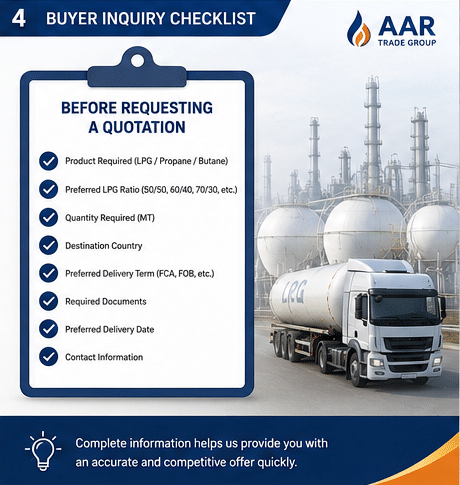
To help us prepare an accurate commercial offer, please include the following information in your request:
- Required product (LPG, Propane, Butane)
- Preferred propane and butane ratio
- Quantity required
- Destination country
- Preferred delivery term
- Expected delivery schedule
- Any specific documentation requirements
Providing complete information allows our team to evaluate your project efficiently and prepare a quotation that matches your commercial and technical requirements.
Our team aims to respond to serious business inquiries as quickly as possible.
We look forward to building long-term cooperation with distributors, trading companies, and industrial buyers seeking reliable LPG supply from Iran.
How quickly can a quotation be prepared?
The response time depends on the completeness of the inquiry. Buyers who provide detailed product specifications, quantity, destination, and delivery terms generally receive quotations more quickly.
Why work with AAR Trade Group?
We believe successful international trade is built on clear communication, transparent business practices, realistic scheduling, and long-term cooperation.
Rather than offering standard answers, we work closely with buyers to understand their project requirements and coordinate with qualified suppliers to identify suitable commercial solutions.
Final Thoughts
Finding a reliable LPG supplier involves much more than comparing prices. A successful transaction depends on selecting the right commercial partner, agreeing on clear specifications, preparing accurate documentation, and maintaining transparent communication throughout the export process.
Whether you are an LPG distributor, trading company, or industrial buyer, careful planning at the beginning of a project helps reduce commercial risks and supports a smoother purchasing experience.
At AAR Trade Group, we aim to assist international buyers by coordinating with qualified suppliers, supporting commercial discussions, and helping facilitate efficient export transactions based on each customer’s specific requirements.
If your company is exploring LPG sourcing opportunities from Iran, we welcome your inquiry and would be pleased to discuss your project requirements.